


I’m continuing my slower summer rhythm, writing with a little less frequency. In my stead is Carmen Radley, editor and community manager here at the Isolation Journals. It’s a fun one today, so please enjoy! —Suleika

When I took my first real job as a middle and high school English teacher, my mom—a teacher herself—tried to warn me.
“Teaching is hard,” she said. How hard could it be? I thought. I’d get to spend my days talking about books, and I’d have summers off to write and travel!
But it turned out my mom was right. Each morning I woke before dawn, drank enough coffee to set my nervous system to permabuzz, cobbled together lecture notes, then hurried to school before 7 to be first in line at the good copier. It was mental whiplash to shift between my sweet but chaotic thirteen-year-olds and my seniors, who were at turns apathetic, defiant, and overly familiar. (They wanted to call me “Rad-Rad.”) Each afternoon, I came home and collapsed in a post-work slumber to rival the dead. Then I’d wake up, make dinner, grade papers, and plan the next day’s lesson. Over and over again.
I truly admire teachers. I believe teaching is a vocation—a sacred calling—and necessary for the flourishing of society. But there’s almost no scenario where I can imagine myself in the classroom again.
It was the prompt in last week’s newsletter—about chaos days and jobs that shape us—that called to mind those teaching days and what they taught me. I got my first inklings that I was an introvert and began to understand the difference between working harder and working smarter. I also learned I don’t like talking about literature with people who don’t share my love of it. (I’m not sure what I was expecting from those kids—for each class to unfold like a scene from Dead Poets Society?)
But one of the joys of being the editor of the Isolation Journals is that I get to read all the time—books, poems, essays—in search of voices to bring to this community. They find their way to us in all sorts of ways: a writer reaching out, a moving story tucked in the comments section, a fabulous tale I hear over lunch with a friend, like today’s essay by Mary Pauline Lowry. And then comes the best part: we share it with you, and what I’d hoped would happen in my teaching days happens. You fall in love, too.
So with that, I’ll step aside and let Mary spin that tale for you. Her essay, “Helplessly, Hopelessly, Gloriously Human,” is about an airport fiasco—and also about strangers and loved ones showing up with curiosity and grace. I hope it makes you laugh and helps you appreciate some previously underappreciated part of yourself.
—Carmen

Prompt 390. Helplessly, Hopelessly, Gloriously Human by Mary Pauline Lowry
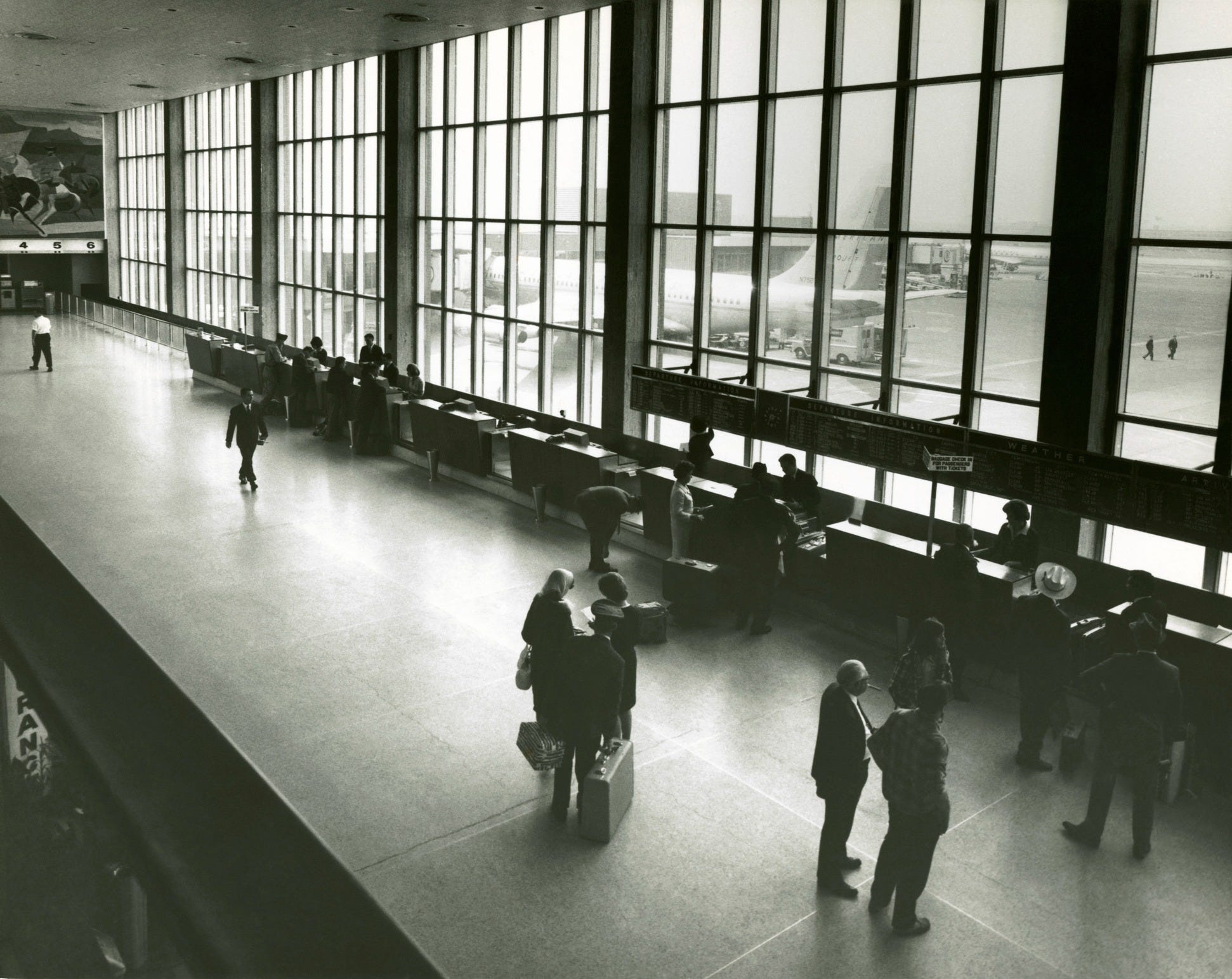
The first sign my travel had not gone as planned was the huge photo collage that read Edmonton. Each letter contained an unfamiliar locale. A river with a large, arched white bridge. A courthouse. A museum.
It was 2016, and I’d been on the last leg of a flight from Austin via Seattle back to Boise, Idaho. Why, I thought, my brain still fogged by Dramamine I’d popped on the layover in Seattle, is there a sign for Edmonton in the Boise airport?
The next one was more startling. An arrow with the word Customs. I asked the woman behind me, in a voice three octaves higher than usual, “What country are we in?”
“Um, Canada,” she said. The word—Canada!—was shocking, like a fuse blowing in my brain.
Hurrying to a customs official behind plexiglass, I said, “I was supposed to fly to Boise.”
“Can I see your passport?” the official asked flatly.
“I don’t have a passport!” I said in my new high-pitched voice. “I have a boarding pass—to Boise! My husband is waiting for me! At the airport! In Boise!” I shoved my boarding pass through the slot, relieved to have proof that my presence in Edmonton—Northern Alberta, Canada—was a colossal mistake.
It was almost eleven o’clock. The customs guy directed me to the airline counter to see about getting an early flight to Boise, where I was supposed to teach a nine a.m. class the next day. The airline employee said a ticket home would cost $1700. My grad student stipend for teaching freshman composition was $800 a month—not much for the drudgery. The curriculum was a wall between me and my students. I longed to apologize, to tell them I loathed making them “write about writing” in unwieldy academic terms. I sensed they’d like me better if I taught them something real. To supplement my income, I wrote profiles of real estate agents for an online magazine. Seventeen hundred dollars would be a lot of profiles.
Another customs official appeared, blonde with a mustache. He told the airline employee that if the airline charged me for my ticket to Boise, they’d face a $200,000 fine for letting me onto a plane to another country without a ticket. I wanted to hug him.
After I was booked—free of charge—for an early morning flight home, I pulled out my phone to text my husband, George. By now, he’d be standing in the Boise airport where the automatic doors open and travelers spill out, waiting for a wife who would not appear. It took a minute to figure out why my phone wasn’t working. I didn’t have international service.
“I can’t call my husband,” I said. “My phone doesn’t work here.”
A gruff traveler behind me handed me his phone. “Why didn’t you ask?” he said.
I didn’t know George’s number by heart. I found it in my contacts and dialed it on the stranger’s phone. He picked up on the second ring. “I’m okay,” I began. “But I’m in Canada.”
George was relieved to hear from me, and unsurprised that something had gone terribly awry. I’d had a lifelong struggle with disorganization; I felt generally unprepared for modern life. Even when not whacked out on Dramamine, I spent, on average, one-quarter of my waking hours searching for something I’d misplaced, and patient George was often roped into helping me. I gave him my new flight details, hurriedly said goodbye, and handed the phone back.
After that, the customs people took me for a formal interview in a private room, then turned me loose for the night. “Come back through security in the morning,” the last official said. Though not before another made a Tom Hanks in The Terminal joke: “You live here now.”
It was cold in the airport, and I was wearing a sundress. (Austin had been roasting.) Using my backpack as a pillow, I lay down on an airport bench and opened my laptop to email my students. I suspected they’d be happy enough to hear their jargon-filled composition class had been canceled—for any reason—but I wasn’t sure what to say. I considered telling them I was sick. Instead, I told the truth.
I was still freezing at six a.m. when I breezed through airport security. In the souvenir shop, I bought myself an Edmonton sweatshirt. At Starbucks I got a hot latte and an Edmonton mug for George from the “I’ve Been There” collection. At my gate, I sat near the airline counter; I could hear the employees whispering. “How did it happen?” one of them said.
How had it happened? The night before I couldn’t fathom it, but now I could see it clearly. Forty-five minutes after ingesting the Dramamine, I had the cognitive abilities of a drunk dachshund. When it was time, they scanned my boarding pass, and I followed the herd of travelers outside, through darkness and pouring rain, along the covered walkway, up the stairs onto a small plane. The darkness, the rain, my Dramamine fog obscured the fact that the plane I boarded had likely been the first in a row of planes, meaning I had choices, and I was making the wrong one. I sat in my assigned seat—which on this sparsely populated flight to Edmonton happened to be unoccupied—and promptly fell asleep.
When I finally arrived in Boise, George was there, ready with a hug. “Only fourteen hours late!” I said.
The day after, when I walked into class, my students were buzzing with conjectures about how and why it had happened—what about her boarding pass? The seat assignment? They all smiled, bigger than they’d ever smiled at me. Before I’d been a grown-up spouting meta-nonsense about writing, teaching them academic concepts I didn’t really believe in.
Now I was the bing-bong head whose goof made their printer mishaps seem insignificant. They liked me better now that I was helplessly, hopelessly, gloriously human.
And I’d finally taught them something they could hang onto: If someone like me was making it through adulthood, they would be just fine.
This is your prompt:
Think back to a fiasco—a moment when you were helplessly, hopelessly human. A mistake, a misstep, a plan gone spectacularly sideways. Write about what happened, what you were afraid it said about you—and what it revealed instead.

We’d love to hear what this prompt brought up for you. Feel free to share in the comments.


Today’s Contributor—
Mary Pauline Lowry is the author of Last Night Was Killer, a comedic murder mystery set in the world of amateur pole dancing—out on July 7. She’s also the author of two previous novels, The Roxy Letters and Wildfire. Her work has appeared in publications such as The New York Times, The New York Times Magazine, O Magazine, and The Millions. She gushes about art and pop culture she loves at her Substack, Make it Funny. Her hottest take is that comedy is the most essential art form.


For anyone navigating chaos days and other assorted fiascos
Watch Suleika’s talk with the wise and wonderful Nadia Bolz-Weber about what we do when shit hits the fan.
It’s a conversation about how we stay human in the hard parts: the rituals that anchor us, the stories we tell ourselves, journaling as a way back to the truth, and choosing joy—not as denial, but as an act of resistance.
June 19: My husband and I drove from the suburbs to Chicago to see “Iceboy!” We were very excited. Advanced word on the play is quite good.
When we got there, it was a little suspect that at 7:05 the lobby was empty for 7:30 curtain time. And there was a black curtain cording off the entrance to the orchestra area. We walked in, and the usher said “they’re about to start; you’re late.” And I said, “what?!?” We have season tickets, and all of our shows are on Thursdays, at 7:30 PM. I was baffled.
My husband ran to the bathroom, leaving me to sort out the problem. The box office was closed, also suspect, though it didn’t occur to me at the time. So I walked up to the information counter and I pulled out my ticket and enlarged it on the screen to show her that it, indeed, said 730 curtain time. It was then that I realized it also said *July 23*.
I popped into the bathroom, and by the time I got out, the usher, who was giggling profusely, had told my husband what happened. Hubby greeted me with a big smile and a hug. It seemed like a boneheaded mistake but I couldn’t figure out how it happened.
It was a beautiful day, so we turned my gaffe into a beautiful evening. We walked to the Art Institute of Chicago and spent an hour there, and then strolled back to our car. We stopped for ice cream on the way home. It was really the serendipitously lovely evening.
Here’s the thing: The play is on our calendar for July 23. At 7:30 We have no idea how it also got on our calendar for June 19. Because it didn’t open until June 20! Turns out we had accidentally almost crashed dress rehearsal at the Goodman.
I remember reading a piece on an airport "fiasco" written by poet Naomi Shihab Nye. It began with time spent on horrid airport plastic seats after a delay/cancellation; hours later, there was a touching conclusion, as the people in this group began to form a community, if only briefly.
Paraphrasing Mary Oliver, What can we do with this one wild and precious life? Well, we can ask for/proceed with grace through difficult moments. Importantly, this allows us to make brief but memorable connections with strangers.
My shout-out, from summer 1994 to a nurse in New York Hospital (now New York-Presbyterian Hospital). My son had been born a day earlier via c-section. My attempts to sleep after a nightime feeding were constantly interrupted by myoclonic jerks. I was alone and panicked, because I couldn't figure out how I'd nurse my newborn if I were sleep-deprived. Bless a young Irish-American nurse: she recognized that the myoclonus was due to adverse effects from the opiate meperidine (Demerol), and was able to arrange for a medication order that gave me a few hours of sleep.
I am in my 8th decade now. I will never forget such moments of kindness from strangers, such as the one I recounted above.