
When the Mind Goes Missing
Day 25 of 30: Nadia Bolz-Weber on packing and grief

What do we pack when we don’t know what’s coming?
Four years ago this week, I was preparing for a long hospital stay. As I approached my second bone marrow transplant, I did what I always do when the future feels uncertain: I gathered, I arranged, I tried to ready myself for what I could not yet see.
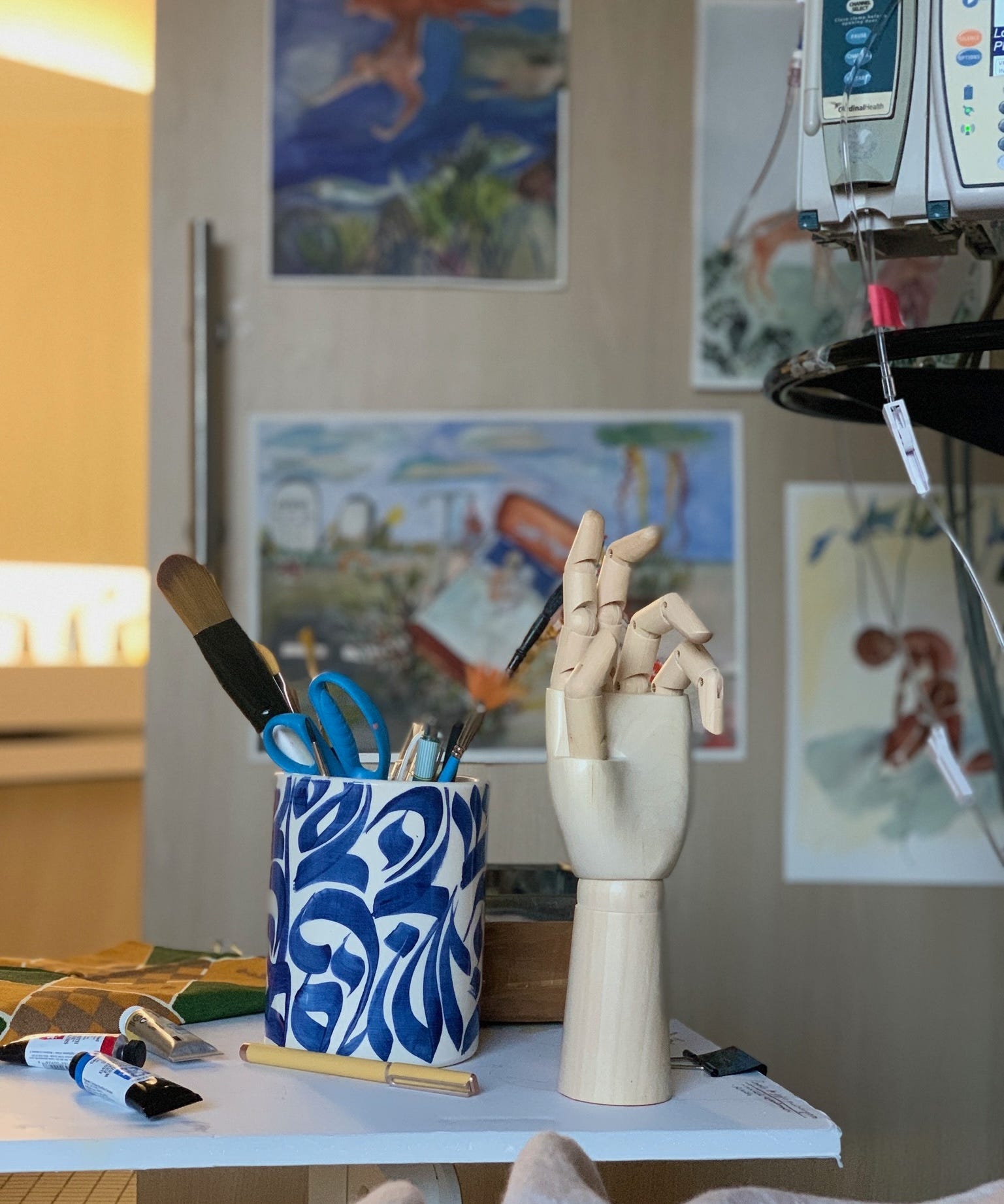
Experience had been a teacher. I didn’t bring tomes like War and Peace this time. (I still haven’t read it.) I left the yoga mat and resistance bands at home. Instead, I prepared for comfort and inspiration—cozy sweatpants, port-friendly hoodies, soft beanies, sheepskin slippers. I brought a stack of journals, my lifeline during the first transplant; a couple of Thich Nhat Hanh’s “How To” books; and an art book of Frida Kahlo’s work. At the last minute, almost as an afterthought, I added a small watercolor set and a few paintbrushes a friend had given me. I slotted it all into a gray felt diaper caddy. So tidy. So controlled.
The irony was that I barely wrote and didn’t read at all. My vision soon doubled from the cocktail of medications, making reading or writing nearly impossible. Texting, too. I told a friend it felt like my phone was autocorrecting—just to the wrong language. Luckily, I had brought those paints. When words failed, color did not. Painting became a kind of visual journal—a way of recording what I was living through when language slipped its grip: the hallucinations, the night terrors, the strange elasticity of time. What I couldn’t name, I could still place on the page.
Over the past year, I’ve spent a lot of time packing and unpacking, both literally and figuratively. I’ve been on the road more than I’ve been home—for The Book of Alchemy and other work events, joining Jon on tour, family trips, and a return to Tunisia for the first time in years. With each trip, I perform the same calculation: if I can fit all the right things into my suitcase—the coordinated outfits, the comfortable shoes, the heating pad, enough nausea meds to sedate a small elephant—then the day might hold.
This is the myth of preparedness—that by assembling the right provisions and safeguards, we might protect ourselves from the discomfort, uncertainty, and pain of being human.
I’m writing this after a disorienting two weeks. The first was all medical: a bone marrow biopsy, five days of chemo, then a donor lymphocyte infusion—an accumulation that leaves me flattened.
The following week, Jon and I traveled to Zurich for the World Economic Forum, not as political power players or industry insiders, but to talk about art—about writing and music as a way of surviving what otherwise feels unbearable.
A friend was on the same flight. He knew I’d finished chemo the day before. “How are you doing?” he asked. Then: “I can’t believe you’re here.”
I wouldn’t normally make such a plan—and I told him so. “This wasn’t Plan A or Plan B,” I said. “This was more like Plan F.” The week after chemo is a wash, between the nausea and the brain fog and the fatigue. But shingles in December pushed my treatment schedule into January, which pushed it straight up against this trip. There was no elegant solution. Only imperfect sequencing.
It was also a few days after my conversation with my friend, the writer and Lutheran pastor Nadia Bolz-Weber, about what to do when the shit hits the fan. The conversation was impromptu; our expectations were low. She told me that since being diagnosed with breast cancer, her brain no longer worked the way it used to, and that she cried easily. I told her I had brain fog, too, and had spent the week on the verge of tears.
We agreed: if we needed to go slowly, we would. If we lost our train of thought, we’d change topics. If we needed to stop after twenty minutes, we’d stop. If we cried, we’d cry.
That is how we proceeded. And in that slowness and vulnerability, something opened. We spoke of illness, and how it alters the shape of our days and our thinking. Of loss, and what it teaches us about love—its power to divide or draw us closer. Of forgiveness and grace, practiced like muscles, strengthened by use. And of joy, chosen even in despair: a flash of phosphorescence in dark ocean water.
But what stayed with me most were those initial caveats. The way they opened the door to gentleness. A refusal to bow to the cultural pressure to be endlessly functional, articulate, productive. An insistence that slowness, fogginess, and mess are not moral failures.
I needed that reminder later during my time at the World Economic Forum, especially on the final night. Jon was meant to speak at an event, and I was scheduled for a roundtable discussion. But a cascade of mishaps followed—traffic, snow, standing in a snowbank on the side of the road as a motorcade sped past.
I thought of this community, and of Monday’s prompt, which asked you to write a letter from the body to the mind. Over and over, you wrote some version of the same message: Hey, I’m here, remember me? I carry you. Sometimes you forget we are one and the same. I had been saving that prompt. (Or avoiding it—there’s so much to unpack.) But in that moment, I knew my body was telling me very clearly to stop, and I had to listen.
And so I turned to Jon and said, “I’m done.”
He nodded, as if this were both reasonable and overdue. There was no way we were making it on time anyway. Back at the hotel, I told him, “I can’t pack. I can’t think. I can’t move.”
“Lie down,” he said. “I’ve got you.”
He packed my suitcase. He located my phone charger, which I had lost. He brought me pizza to eat in bed—proof that he understands both triage and romance. Another moment from my conversation with Nadia echoed back to me: care often arrives not as a grand gesture, but as logistics. Love can look like handling the details when someone else can’t.
One of the things I admire most about Nadia is that she never rushes toward resolution. She doesn’t offer fixes or prescriptions. She offers accompaniment. In a culture obsessed with self-help and panaceas, this feels quietly radical: to sit with what hurts, to be gentle with a mind or body undergoing a profound recalibration.
So today, I want to share Nadia’s essay from The Book of Alchemy. It’s called “I Packed for Shit That Day.” It doesn’t tell you how to grieve well or heal quickly. It simply stays with you when the map disappears.
After the essay, you’ll find today’s prompt—an invitation to practice gentleness. To reflect on a time you extended yourself grace, or a time someone else helped you pack, literally or figuratively. Or a moment when gentleness felt out of reach, and what you might do differently next time.
May Nadia’s words keep you company when shit hits the fan.

Prompt 368. I Packed for Shit That Day by Nadia Bolz-Weber
When I answered my phone on a Friday morning in August 2021, and my sister said, “Someone killed Henry”—her son—my mind rejected the words. I knew what they meant individually; I knew what “someone” meant and what “killed” meant and what “Henry” meant. But together, they were indecipherable.
So I said, “No.”
Reader, I’m not sure how many times in a row I said no, but it was many, many times. No is the only response my mind had to the words “someone” and “killed” and “Henry” all in a row. So my mind grabbed the biggest NO it could find, placed it between her hands, and tried to keep those three impossible words out.
It didn’t work.
A couple days later, I was packing to fly to where Henry had been living—my husband and I were going to clean out Henry’s apartment for my sister—and I realized that I no longer knew what to put in a suitcase. I am a seasoned traveler, and up until that moment, my mind had been really good at this task. She knew how many shirts to include, what size travel toothpaste is allowed, and where my toiletry case is. But this time, she failed. I failed. I packed for shit that day.
I guess one way to think of it is that I’d lost my mind. But another way is this: my mind had to take to the skies, it had to go circle the globe, and then dig itself a hole in which to rest in order to ever come back to me.
So, sweet reader, how do you grieve without losing your mind?
You can’t.
The poor thing is undergoing a prolonged software update. Because it had understood the world one way—as one in which nephews aren’t shot to death—and that world doesn’t exist anymore.
It had a way of understanding a world in which your best friend doesn’t suddenly betray you, or a world in which other people have cancer but not you, or a world in which your husband still loves you, and that world doesn’t exist anymore.
So if your mind doesn’t remember to pack underwear, or how to keep showing up for work, or the name of the person who cuts your hair, try and just be gentle with it. It will come back, but it and you will be changed.
No one escapes this, my friend—which sucks. But it’s also a comfort, because you’re not alone in the madness. And we who have also lost our minds with grief will overpack for you. Just in case.
This is your prompt:
Write about being gentle with yourself in grief. Maybe about a time you extended yourself grace. Maybe about a time someone else showed up and helped you pack (literally or figuratively). Maybe about a time you weren’t gentle, but how you plan to be next time.
Optional musical pairings:
Caroline Shaw with Sansara, “I Will Hold You”
Caroline Shaw & Sō Percussion, “Sing On”

Today’s Contributor—
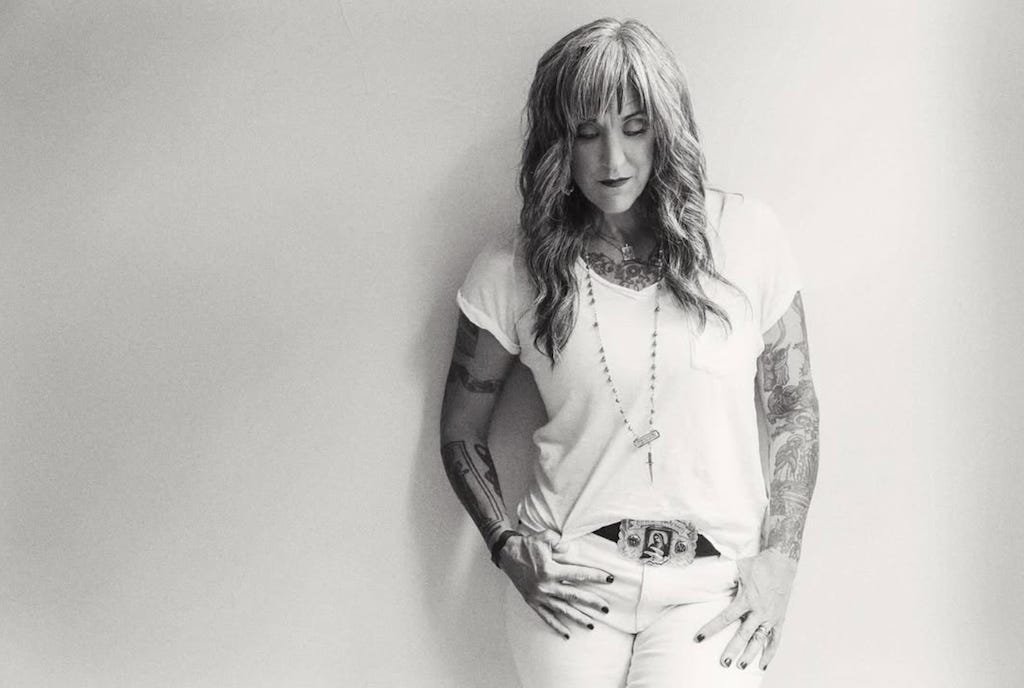
Nadia Bolz-Weber is an ordained Lutheran pastor and the author of three New York Times bestselling memoirs: Pastrix: The Cranky, Beautiful Faith of a Sinner & Saint, Accidental Saints: Finding God in All the Wrong People, and Shameless: A Sexual Reformation. She writes and speaks about personal failings, recovery, grace, and faith and always prefers to sit in the corner with the other weirdos. You can keep up with her recent writing in The Corners.


When Shit Hits the Fan
Earlier this week, I shared the video of my full conversation with Nadia—where we talked about why despair won’t save us, the necessity of renouncing empty promises, and the holiness of something as ordinary as a Pyrex dish. Paid subscribers can watch the full conversation.
The Sunday newsletters always hits hard. When Suleika said 'I'm done' and Jon kicked in, i cried so hard. What a beautiful love. Thank you for sharing. This prompt reminded me of when I broke my foot in 2021 and had to be cared for by my daughter. What should have been 6 weeks on crutches ended up being 5 months due to complications. I lost my mind and my mental health, but she kicked in high gear and was my life-saver. On a side-note, can we talk about how texturized and full our journals are getting with this 30 day project? The maps and collages..I've never loved my journal more than this one. Thank you for showing us new ways to journal by adding crafts and various mediums, and textures. Happy Sunday everyone!
After reading this morning’s prompt, I went to the kitchen to start my coffee. My father-in-law came hobbling out of his bedroom, left leg dragging slightly behind the right as he steadied himself against the half-wall that draws a straight line from his room to the kitchen.
“Well,” he started with a heavy tone, “Lola passed about six this morning.” I walked toward him and put my arms around his crooked body.
“I’m so glad you went to see her last week,” I said. He had made the four hour trek across the state several days ago to spend time with Lola, his mother’s best friend who had had a stroke and been moved to the hospice wing of the nursing home she resided in.
“I’m glad I got to hear all those ‘I love you’s she said to everyone,” he said wiping a tear from his cheek.
When he had returned from seeing her the other day, the thing he highlighted the most about his visit was that Lola was in a constant state of saying “I love you” to everyone who walked in the room. I asked him if it felt like an absent sort of rote statement or if she was genuinely present with her words (I’ve never met Lola and was trying to get a sense of both her as a woman and the extent of the stroke).
“Oh no,” he had reported, “she meant it every time.”
So I’ve been sitting with this the last few days. “I love you. I love you. I love you.”
Approaching the gate of death, as Lola knew she was doing, made one thing clear to her: she was in love with everyone and everything in her life. And in a moment that could have easily been met with fear or dread or overwhelming sorrow, she opened to love and got to share that - shower that - with all her loved ones who came to hug her one last time.
What a tender gift… to remind everyone who will be grieving in your wake, that what they are experiencing is being loved.