

Recently I wrote about how I’m shifting to a slower summer rhythm and writing with a little less frequency. In my stead today, I’m excited to introduce my husband, the Oscar, Emmy, Golden Globe, and eight-time Grammy award-winning musician, Jon Batiste.
Some of you may recall that a couple years ago, around the debut of his album Beethoven Blues, he wrote an essay about authenticity, imagination, and breaking musical barriers. “When we allow forms to evolve, we find new frequencies,” Jon wrote. “Throughout history, when people decided to go against the standard practice, to depart from the norm—whether in music or some other medium—it has led to an expansion or refinement or general improvement of the human condition. How many times has that happened? That’s pretty much the whole history of any positive evolution in creativity and culture: somebody takes what has come before, and while respecting it, while revering it, they bring it into the present to create the future.”
Jon has continued this conversation with the past. Black Mozart, the second installment of his ongoing piano series, comes out later this week.* To celebrate, I’m sharing an excerpt from his album liner notes (an art form unto itself!), a song from the album, and a prompt inspired by it. May it move you.
One final thing: Don’t forget about Journaling Club today! Jon will join to talk about music-making and give us a sneak peak of his new album. You can find the Zoom link here. Just upgrade to join us if you haven’t already!
[*Editor’s Note: Due to delays in vinyl production, Black Mozart’s release date has been moved to August 14, 2026.]

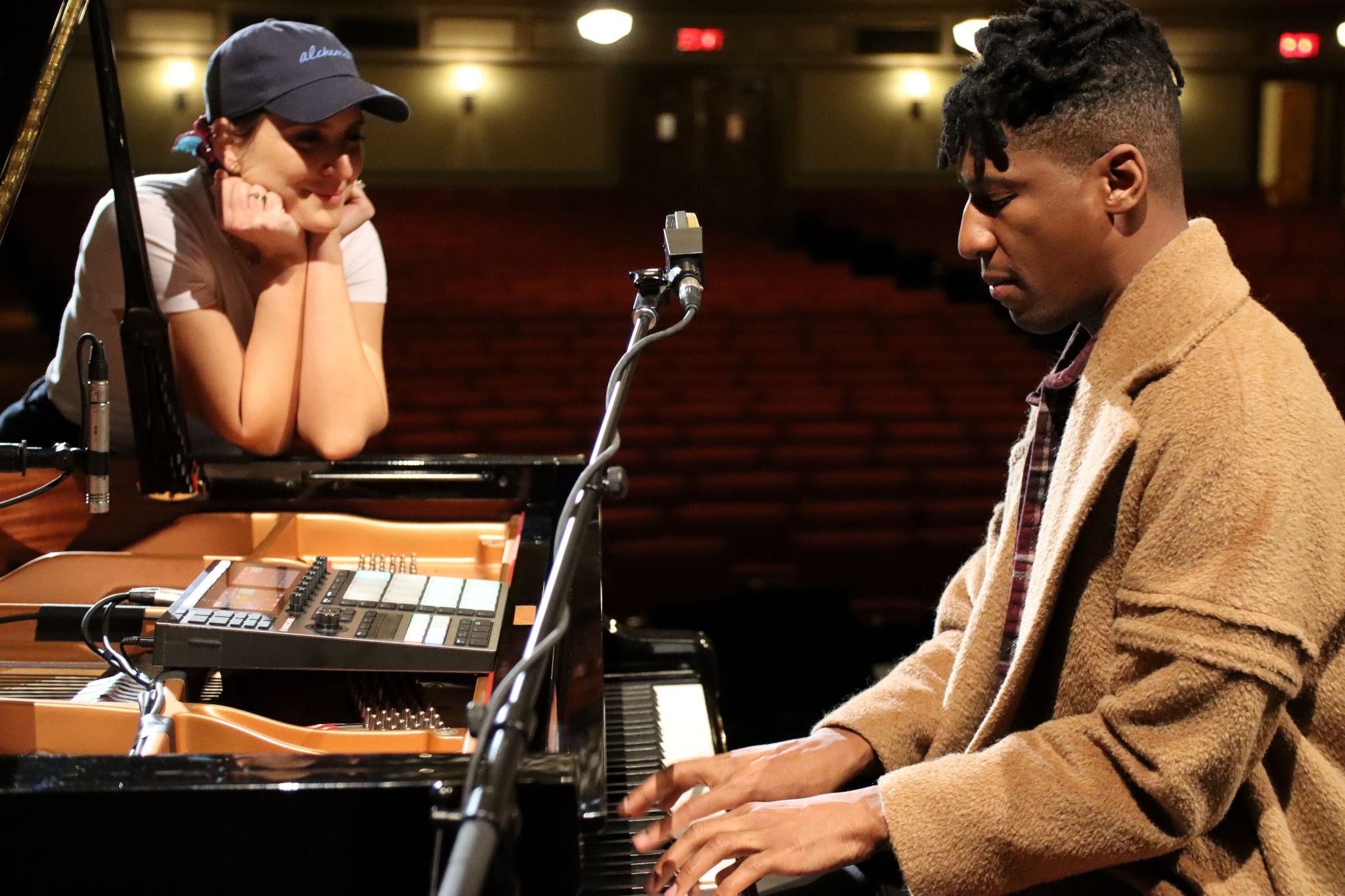
In reinterpretation you must not strip the music of its essence—that conversation between its mathematical construction, rhythmic structure and melodic innocence. If you alter one element of that special alchemy the wrong way, it loses its potency and identity. Like Thelonius Monk, for me a latter-day example of all the same qualities, Wolfgang Amadeus Mozart was a meticulous metaphysician who created a special blend of logical mastery that still somehow defies explanation.
Mozart didn’t have large pendulum swing eras where his musical approach shifted dramatically. He absorbed what was in his orbit while the core of his approach remained consistent. Somehow his music was always modern.
He also absorbed everything that led to him. He was the obvious successor of Johann Sebastian Bach: both were keyboardists, supreme improvisers, providers of melody in all registers and purveyors of the percussive left hand. If Bach was a foundation, Mozart was a bridge that eventually led to the modern age.
M is for Modern. Metaphysical. Melodic. Mathematical. Momentous. Monolithic. Manifestation. Masses of people this music continues to touch.
M is a bridge in spiritual symbolism too, between the material and spiritual realms. It’s the 13th letter of the alphabet, a numerological 4 (1 + 3) representing stability, structure, and order but off-balance enough to crescendo forward. The nickname Amadeus is the Latin translation of Mozart’s baptismal middle name, Theophilus, both meaning “loved by God” or “lover of God.”
M is also for Music. Pure music. It exists in the material world but creators like Mozart already have one foot on another plane of existence, just passing through.
A key aspect of Mozart’s music of immense potency is how accessible and elementary it is—humble, singable melodies not overwritten—capturing the essence of childhood. There is an innocence to the sound that you can hear even without any understanding of music.
Even still, my first impressions of Mozart’s music weren’t completely favorable. It felt a little too “stuffy” for me and didn’t immediately capture my imagination.
Then my mentor Alvin Batiste helped open my ears. He took his love for Mozart’s melodic approach and composed a twelve-bar blues tune based on the vernacular, embedding that influence into a foundational black American idiomatic form. This was the seed planted that eventually got me to love his music too.
Basically, he took what he loved about Mozart and reimagined it as Black American classical music.
I found this music when I was a kid and some twenty years later I am still reimagining to extend the implications I see within it.
I reimagined Mozart “black” in the tradition of Mr. Batiste, imbuing it with influences from jazz, rags, stride, blues, stomps but still maintaining its core essence of modern classical music. Like my last album in this series, Beethoven Blues, this is a conversation without words, not about genre but about commonality, improvisation, expression, and innocence, in that spiritual realm where M really lives.
—Jon Batiste, from the liner notes to Black Mozart


Prompt 388. Alla Blues by Jon Batiste
This is your prompt:
Position your body comfortably—lying down, seated in a chair, standing, whatever feels right to you. Listen to “Alla Blues.” Notice what happens in your body. Do you relax into it? Do you feel the urge to move to it? To hum or sing along? What plane of existence are you on by the end?

We’d love to hear what this prompt brought up for you. Feel free to share in the comments.


Today’s Contributor—
Jon Batiste is an Oscar, Emmy, Golden Globe, and eight-time Grammy Award–winning musician from Louisiana. He earned a BA and MFA from the Juilliard School, spent years playing music on subways and in the streets of New York City with his band Stay Human, then served as the bandleader and musical director of The Late Show with Stephen Colbert from 2015 to 2022. He has released eight studio albums, including We Are, which won Album of the Year in 2022, and Beethoven Blues, which reached #1 on Billboard’s Top 100 for Contemporary Classical and Classical too. Black Mozart is available for preorder now.

More from Jon—on rejection, permission, imagination, and red beans:
On Failure
An interview with Jon where he talked about his philosophy of “getting your rejection in,” how you’re not trying if you’re not failing, and shared a recipe for his Ma’s red beans.
A Creative Heart-to-Heart
A raw, unfiltered conversation about life and the creative process, where Suleika and Jon talked about trying to find the wave, figuring out what your creative triggers are, expanding your creative tool kit, and joy as a practice.
Getting Free with Jon Batiste
An impromptu conversation where Suleika and Jon talked about first lines, the tyranny of the blank page, and the permission to just free yourself and begin.
Beethoven & the Blues
An essay on authenticity, imagination, and Beethoven and the blues.
I have been listening to Jon's Beethoven Blues every day several times a day for the past 2 months. My mom always played Für Elise and Moonlight Sonata he me since I was a little girl. Listening to him play has helped heal my heart and make me feel close to her.
Thank you Jon for your gift of music and helping me heal.
I miss you mom and I hope you are listening in heaven. ❤️
I was awake but still in bed when I read this and listened. I closed my eyes, curious and open to experience. I saw the sea, the little foamy waves crawling up the sand. Some foam leaving upwards, blowing in the wind. Quiet happy feeling, deeply touching, tranquility. Rhythmical nourishment.